Proposal to build 1,200 new houses next to Martlesham Heath would be disastrous for nature

Proposal to build 1,200 new houses next to Martlesham Heath would be disastrous for nature

We're objecting to a major housebuilding scheme next to a protected heathland east of Ipswich - and asking the developer to rethink their proposals to make them better for wildlife and local people.

Quick summary

  • The proposed Bloor Homes development would be another nail in the coffin for nature.
  • Ipswich's last surviving fragment of heathland could be lost forever.
  • The heathland is a Site of Special Scientific Interest (SSSI), home to nationally rare bats, bees, birds and butterflies.
  • The proposed measures to safeguard wildlife are unlikely to be effective. 
  • Suffolk Wildlife Trust is calling for the development to adapt its plan to prevent all harmful impacts on wildlife, and deliver positive outcomes for nature and people.

Take action to save this site


Our Head of Planning and Advocacy, Rupert Masefield, said:  

“For too long, we have failed to prevent new development from damaging our best places for wildlife; places that are increasingly rare and precious for nature and people. That must change.

"It's not enough for development to just avoid making things worse for our local wildlife; we need development that is genuinely good for nature and helps it to recover and thrive.

"Bloor Homes’ proposals next to Martlesham Heath fall short of that ambition, which is why we are asking them to go back to the drawing board and design a scheme that is better for nature and people.” 

Foxhall Heath, Martlesham Heath, Ipswich (c) Gemma Cosson

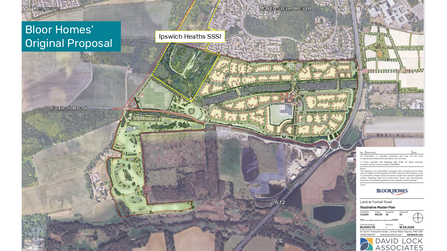
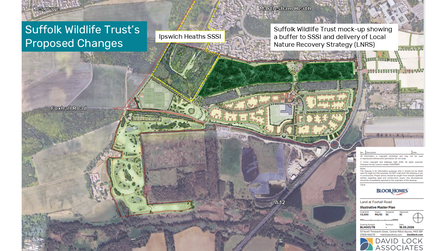
Click or tap the maps below to see them in full. Then click the arrows to compare Bloor Home's original proposal and our suggested changes.

What is being proposed?

Bloor Homes have applied for ‘outline planning permission’ for up to 1,200 new dwellings on land to the north of Foxhall Road, which lies on the edge of Ipswich and immediately to the south of Martlesham Heath, in the East Suffolk Council district.

An outline planning application seeks permission for the broad parameters of development, but defers the details of the proposals, such as the design and management of wildlife habitats, parks and green spaces, to later Reserved Matters applications. 

While the outline proposals include some measures to reduce harm to wildlife, these would not be sufficient to prevent long-term damage to important habitats and the species that depend on them. 

Foxhall Road Development, Bloor Homes Original Proposal

Foxhall Road Development, Bloor Homes Original Proposal

What is Suffolk Wildlife Trust concerned about?

The proposed housing is located next to one of the best remaining examples of Suffolk Sandlings heath near Ipswich, and part of the nationally important and protected Ipswich Heaths SSSI.  

These remnant heathlands are refuges for rare and vulnerable species like the silver-studded blue butterfly and Dartford warbler, which has been recorded nesting within part of the heathland owned by Bloor Homes. Surveys have shown the site supports numerous rare and threatened invertebrates, including the Critically Endangered Breckland leatherbug, the Nationally Rare vernal shieldbug, and Red-Listed ashy furrow bee and five-banded weevil wasp. 

The heath is already under extreme pressure from recreational impacts, disturbance and dog fouling, which are key reasons for its ‘unfavourable’ and declining condition.  

Bloor Homes have promised to implement a management plan with the aim of improving the condition of the part of the heath they own, but this is unlikely to be possible in practice due to the persistence of existing pressures, which will only increase under the housebuilder’s current proposals. As the owner of a SSSI heathland, Bloor Homes are required to manage the site effectively and appropriately and should be doing this already. This should not be dependent on their ambitions to build 1,200 houses next door.  

The wider site of the proposed development has also been found to be of exceptional value for a wide range of wildlife, from bats and birds to reptiles and invertebrates. For example, the site is home to 11 nationally rare and 81 nationally scarce invertebrate species, making it a regionally important site for invertebrates. It is not clear that negative impacts on these and other species and the habitats they depend on would be adequately avoided by the current proposals.  

According to the submitted plans, around half of the proposed 1,200 new houses would be built on 37 acres of land (equivalent to more than 20 football pitches) to the north of Welham Plantation and south of Martlesham Heath – land the Suffolk Local Nature Recovery Strategy identifies as a priority area for creating heathland and acid grassland habitats to increase, improve and connect valuable wildlife habitats across the county. If permitted, this land would be lost to nature recovery. 

Measures that the proposals claim would reduce impacts on protected wildlife habitats are unlikely to be effective in practice. For example, the main area of ‘Suitable Alternative Natural Greenspace’ the scheme must provide to reduce recreational pressures on more sensitive wildlife sites are located to the south of Foxhall Road, while the houses would be to the north – some of them more than a kilometre away, where people are less likely to walk the distance to access these areas. 

Finally, the proposals indicate that Bloor Homes owns at least another 300 acres of land in the area immediately around the site of this proposed housing development – land that has been submitted to East Suffolk Council for potential allocation for more housing development in the future as part of the review of the area’s local plan. It is our view that the current proposals cannot be looked at in isolation and should be considered in the context of Bloor Homes’ ambitions to build more houses in the area in future.

What is Suffolk Wildlife Trust asking for?

The exceptional value of this site for biodiversity means any new housing should be required to achieve the highest standards of mitigation and compensation for harmful impacts, and deliver significantly more than the minimum enhancement for nature.  

We are calling on Bloor Homes to redesign the scheme to ensure that this major new housing development delivers genuinely positive outcomes for local wildlife and people. This includes: 

  • Restoring the land north of Welham Plantation and south of Martlesham Heath to create a large new area of wildlife-rich heathland and acid grassland habitat, connecting to existing SSSI heathland and providing accessible greenspace for new home occupants and surrounding residents. (See map X – would help visualise this). 
  • Avoiding building houses on land that the Local Nature Recovery Strategy (LNRS) says should be prioritised for creating and restoring heathland and acid grassland habitats.  
  • Providing exemplary mitigation and compensation for unavoidable adverse impacts to protected wildlife habitats, including heathland creation and enhancement. 
  • Setting industry-leading standards for the area and quality of accessible nature-rich greenspace on people’s doorsteps to improve health and social equality for existing communities and future residents.
Foxhall Road Development, Suffolk Wildlife Trust Proposed Changes

Foxhall Road Development, Suffolk Wildlife Trust Proposed Changes

#action

Take action to save Ipswich's last fragment of heathland

If you agree that this major new housing development on the edge of Ipswich should do more to protect and restore nature for wildlife and people, you can do so by taking the actions below before 3rd December 2026.

I'm an East Suffolk Council resident and want to take action...

1. Respond to the proposal

Share your views on this proposed development on the East Suffolk Council website. You will need to log in.

Alternatively, you can email planning@eastsuffolk.gov.uk with the subject ‘FAO Danielle Miller - DC/26/2312/OUT’

Please also copy in campaigning@suffolkwildlifetrust.org.

Response template for planning officer 


2. Contact your local councillor

Use www.writetothem.com to send an email to your local councillor.

Or find your East Suffolk Council contact details here.

Please copy campaigning@suffolkwildlifetrust.org into any emails you send.

Email template to local councillor  


3. Share on social media

Help us raise public awareness by sharing this news story with your friends, family and community and help protect nature.

Remember to tag @BloorHomes and @EastSuffolkCouncil if you can.

I’m not an East Suffolk Council resident, but I want to help...

I’m not an East Suffolk Council resident but I want to help

Share your views with Mark Packard, East Suffolk Council’s Cabinet Member for Planning and Coastal Change, at mark.packard@eastsuffolk.gov.uk.

Please copy campaigning@suffolkwildlifetrust.org into any emails you send.

Email template to Councillor