

Skylark - David Tipling/2020VISION
Skylark
How we're protecting Suffolk's skylark populations, and the habitats they need to survive
Singing high above our fields and marshes, the unmistakable chattering song of the skylark is one of the most joyful sounds of the British spring and summer. Nesting in open heathland, saltmarsh, and pastoral fields, skylark build their nests on tussocky ground where their young can feed on spiders and insects, while looking out for approaching predators. Skylarks have also adapted to nesting in arable fields with short-growth crops.
Over the winter months, adult skylarks eat a mix of grass seeds and the leaves and seeds of arable weeds that emerge after autumn harvests.
Sadly, like many of Britain's birds, skylark populations have plummeted in recent decades with an estimated loss of over 60% since the 1970s; making the skylark a red-list bird of conservation concern.
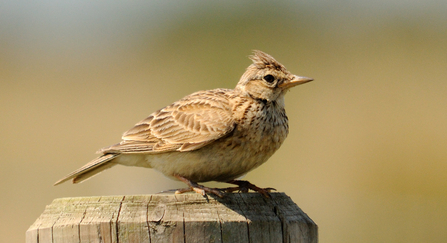
Skylark by Amy Lewis
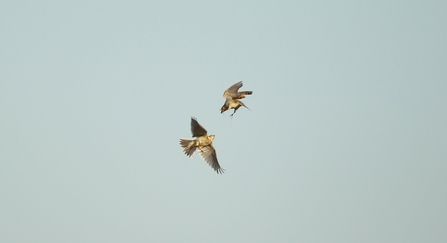
Battling Skylarks by Luke Massey

Skylark by Amy Lewis
This decline is largely due to the increase in crop farming over winter, made possible by climate change, which has reduced the availability of winter food sources and spring nesting habitat. The ongoing use of pesticides in agriculture has also resulted in significant declines in invertebrate numbers, which young skylark chicks rely on for food.
But it's not too late to turn things around. At Suffolk Wildlife Trust, we work with farmers and landowners across the county to protect and restore skylark habitats, but supporting wildlife-friendly land management practices. We also work hard to maintain heathland, saltmarsh, and grassland habitats on our nature reserves, which have become vital havens for breeding skylarks.
How Suffolk Wildlife Trust is helping skylark
Working with farmers and landowners
Our nature reserves alone cannot provide all the habitat skylark need to survive. That’s why our Farm Wildlife Advice team supports farmers and landowners across Suffolk to implement wildlife-friendly farming practices and land management techniques that don't disturb and destroy skylark habitat and the natural food sources.
By altering crops and managing grassland areas, farmers can continue to produce food and resource whilst also providing skylark populations with the space they need to recover.
In south Suffolk, our Wilder Landscapes team is developing a Landscape Recovery project - Connecting Constable & Gainsborough Country - which aims to establish a partnership of 64 farmers across a vast area of the county to unlock sustainable farming and nature recovery together.
Managing habitats on our nature reserves
Across many of our grassland and heathland nature reserves, we carefully manage habitats to create optimal conditions for skylarks and other ground-nesting birds. Conservation grazing with sheep, cattle, or ponies helps to keep grassland short and uneven, providing ideal nesting conditions. It also naturally increases plant diversity, supporting the invertebrates that skylark chicks feed on.
On some reserves, we carry out annual grass and reed cutting to maintain tussocky features and manage the development of scrub. This is balanced by leaving areas for plants to go to seed, providing important food sources for skylarks.
By delivering habitat management and creation targeted at skylarks, we are stabilising Suffolk’s skylark population and giving them the space they need to recover - setting them on the path to becoming abundant once again.
Campaigning for better support for farmers
Agriculture is one of the biggest contributors to habitat loss and fragmentation, as well as pollution from pesticides. Many farmers want to support the countryside and the wildlife they share their land with, but Government demands - driven by consumer demand - often force them to choose between higher production and caring for nature.
Our Planning & Advocacy and Campaigning & Activism teams engage with Suffolk MPs to make nature-friendly farming a higher priority for the national Government, so that farmers can support skylark and other farmland wildlife without risking their livelihoods.
We also work with The Wildlife Trusts federation on national campaigns to uphold environmental regulations and halt nature's decline.