

Terry Whittaker/2020VISION
Stag beetle
Saving Suffolk's stag beetles by creating deadwood habitats
Stag beetles are Europe’s largest beetle. Yet despite their size and formidable jaws, their numbers have declined dramatically due to habitat loss; particularly the loss of dead and decaying wood habitats that are critical to the beetle's lifecycle.
Most of a stag beetle’s life is spent as a larva, feeding on rotting wood for several years. The mature larva then leaves the wood to form a cocoon in the soil, before pupating and emerging as an adult. The adult beetles are only alive for a few weeks, meaning it's vital they find dead or decaying wood quickly to lay their eggs.
In Suffolk, we're lucky to have nationally significant populations of stag beetle in the south of the county in Ipswich, along the River Stour, and across the Dedham Vale National Landscape. Their numbers in these areas are stablising, but continuous action is essential to secure their future.
At Suffolk Wildlife Trust, our Wilder Communities and Wilder Landscapes team are working with community groups and landowners across Ipswich and southern Suffolk to create stag beetle stacks (also known as stumperies) in local parks, school grounds, and green spaces. The stacks - semi-buried broadleaved logs - provide the beetles with the woody habitat they critically need to survive as a species.
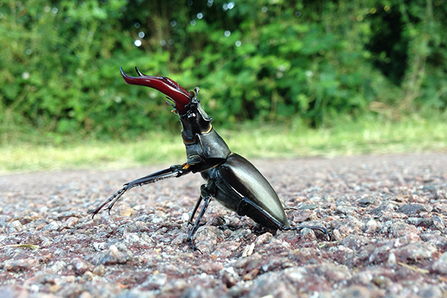
Male stag beetle by Steve Aylward
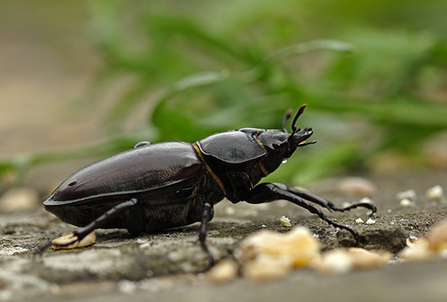
Female stag beetle by Sherie New
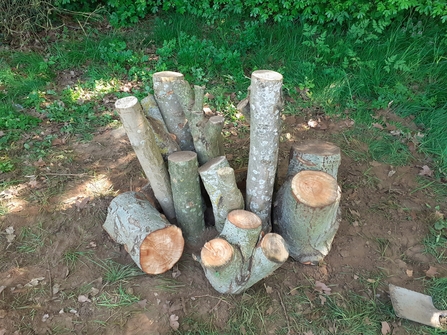
C Zakss
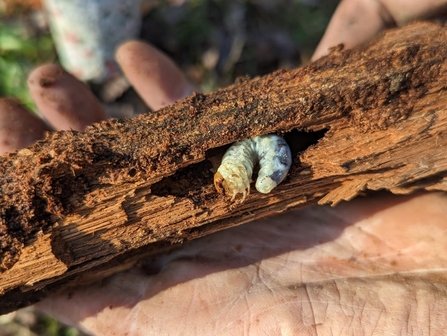
Stag beetle larvae at Newbourne Springs, Joe Underwood
How to create a log pile for stag beetles
Creating a log pile for stag beetles - known as a stack or stumpery - is one of the best ways you can help Suffolk’s stag beetles. Why not create a stack in your garden, in a green space in your neighbourhood, or encourage your school or workplace to create one in their grounds?
- Select wood from broadleaved trees. Oak and beech are best, but elm, ash, willow, cherry, and apple are great alternatives. Avoid conifers (such as pine and fir). Fresh logs with bark attached are best, as they provide variation and rot more naturally. Logs should be at least the thickness of an adult’s arm — but the bigger, the better!
- Place the logs in partial shade, which will help prevent them from drying out. It’s best to position logs vertically, so adult beetles can access the core of the wood. Logs can also be laid horizontally, but avoid piling them too high, as logs on the top will dry out too quickly. Do not stack logs against existing trees or hedges, as decomposing wood may cause disease in healthy plants.
- Leave neighbouring plants to grow over and around the logs. This creates shade and humidity, helping to keep the wood damp while also creating richer habitat for stag beetles and other invertebrates.
- Avoid mowing close to log piles between May and August, when adult stag beetles are emerging. You wouldn’t want to accidentally harm one after all your hard work!


