

Nightingale © Chris Gomersall/2020VISION
Nightingale
How we're protecting Suffolk's nightingales, and restoring their natural habitat.
Nightingale are a shy, unassuming, sandy-brown bird most famous for their beautiful, melodious song - which has inspired musicians, artists, and nature-lovers alike since Anglo-Saxon times. They're a migrant bird that overwinters in West Africa, typically arriving in Suffolk in April where they stay for just a few months to breed and nest before embarking on their epic journey back to Africa.
Sadly, the nightingale's song has become an increasingly rare sound in the UK. Their populations have suffered devastating losses of over 90% due to large-scale agriculture and rising deer populations disrupting and destroying their natural habitat.
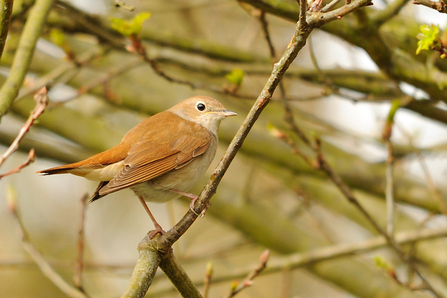
Nightingale - Amy Lewis
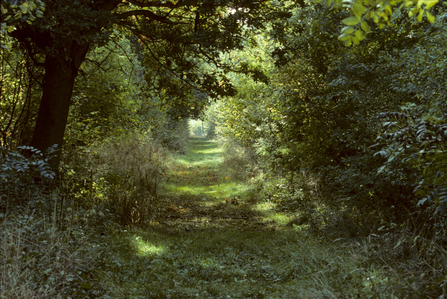
Bradfield Woods - Andrew Bennett
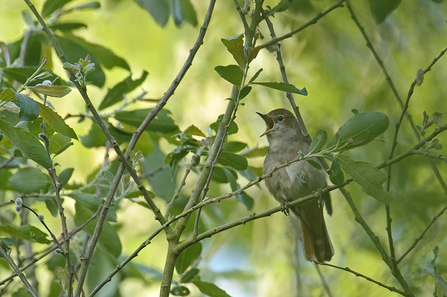
Nightingale - Chris Gomersall
Jesse Walker
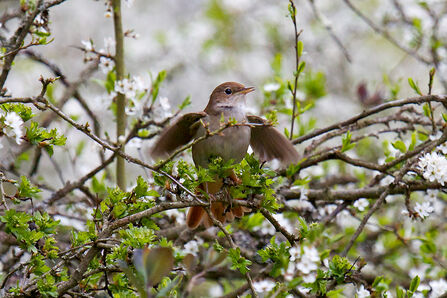
Nightingale by David Martin
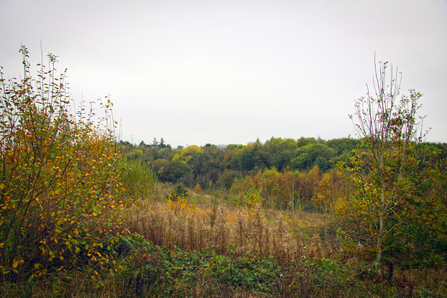
Like many of Britain's birds, nightingale rely on thick hedgerows, wild scrubland and woodland edges with hawthorn, blackthron and bramble for nesting and foraging for inverterbrates. Unfortunately, these types of habitats are too often seen as "messy" and have been removed from the countryside and suburban areas at an alarming scale.
That's where we come in. At Suffolk Wildlife Trust, we're working hard to protect the few remaining remnants of these scrubby habitats in Suffolk, and restoring wilder areas on our nature reserves and across the county to give nightingales the space they so desperately need.
How Suffolk Wildlife Trust is helping nightingale
Managing habitats on our nature reserves
At many of our nature reseres we have nationally important strongholds of nightingale. Most notably at Arger Fen & Spouse's Vale, Black Bourn Valley, and Martlesham Wilds because of their complex, natural patchworks of scrub and woodland.
Within our reserve management plans, we have dedicated activity designed to protect existing scrub and wooland habitat and restore even more habitat. The ancient coppice woodland of Bradfield Woods has a dense, well-developed understory which provide nightingale with nesting sites and food sources. Similarly at Arger Fen & Spouse's Vale, the mosaic of ancient, wet, and regenerative woodland - intersperesed with mature scrub - have sustained nightingale populations for centuries.
Meanwhile at Martlesham Wilds, we're providing the landscape space and time to naturally regenerate; with the woodland edges beginning to extend into the former arable fields, resulting in a thicker hedgerows and young scrub to establish.
By delivering habitat management and creation that’s targeted for nightingale, we’re protecting Suffolk’s nightingale population and giving them a chance to recover.
Working with farmers and landowners
Our nature reserves alone cannot provide all the habitat that Suffolk's nightingale populations need to survive and thrive. That’s why we work with farmers and landowners across the county to restore, expand and reconnect their scrub and woodland habitat across the landscape of Suffolk.
Our Farm Wildlife Advice team works with farmers in every part of Suffolk to encourage, support and develop wildlife-friendly land management that provides bigger and better habitats for nightingale. Creating thicker, more biodiverse hedgerows and woodland areas on farms not only provides vital habitat for nightingale, but also helps to boost the number of insects which nightingale feed on.
In south Suffolk, our Wilder Landscapes team is supporting farmers to develop a Landscape Recovery project - Connecting Gainsborough & Constable Country - that aims to restore and reconnect woodlands at a huge scale, with specific goals to create more nightingale habitat.
Campaigning for nature-positive planning
Agriculture, housing, and infrastructure are the biggest contributors to habitat loss and fragmentation. Despite nightingale being highly protected under the Wildlife and Countryside Act 1981, these protections are constantly under threat by Government and developers.
Our Planning & Advocacy team engage with developers and local councils to ensure protected species and habitats - including nightingale and ancient woodlands - are not disrupted or destroyed by new development in Suffolk.
We also work with the Wildlife Trusts federation on national campaigns to uphold environmental regulations and halt nature's decline.